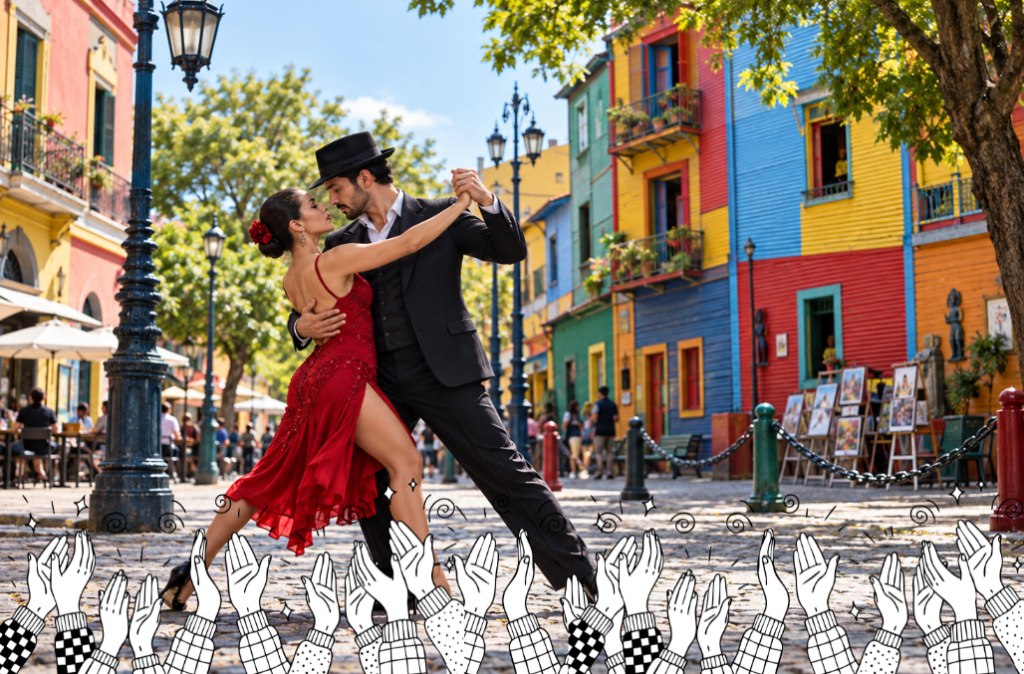
There are some ideas about Buenos Aires that are widely circulated.
Tango. Beef. Mate. Late dinners.
Some have a grain of truth. Others need a little context.
With this article, we’re kicking off a series to take a closer look at these myths and better understand the city before you travel.
Does everyone in Buenos Aires dance the tango?
No.
The tango is part of Buenos Aires’ cultural identity, but it isn’t an everyday practice for the entire population.
Some people dance it, others listen to it, and many simply live with it as part of the city’s cultural landscape.
So why is Buenos Aires so closely associated with tango?
Because it was born and grew up tied to the Río de la Plata and had an enormous influence on local culture.
Over time, it has become one of the most recognizable images of Buenos Aires around the world.
Today, it can be found in milongas, shows, classes, music, cultural venues, and certain corners of downtown and San Telmo.
Where can you experience tango in Buenos Aires?
There are several ways.
You can go to a milonga, take a class, or seek out cultural venues where tango is part of everyday life.
In San Telmo and downtown, musicians or dancers may also pop up in busy squares and streets.
You don’t always have to choose a big show.
Tango is there. But it’s not everywhere
That’s perhaps the most interesting point.
Buenos Aires has a much broader cultural scene.
Theater, rock, jazz, urban music, bookstores, cinema, and many other forms of expression coexist with tango.
Tango is an important part of the city. Not the whole city.
A good way to get to know it
If you’re interested in tango, look for an experience that matches what you want to experience.
It could be a class, a milonga, or simply listening to music while strolling through San Telmo.
You don’t need to know how to dance.
Sometimes just watching is enough.