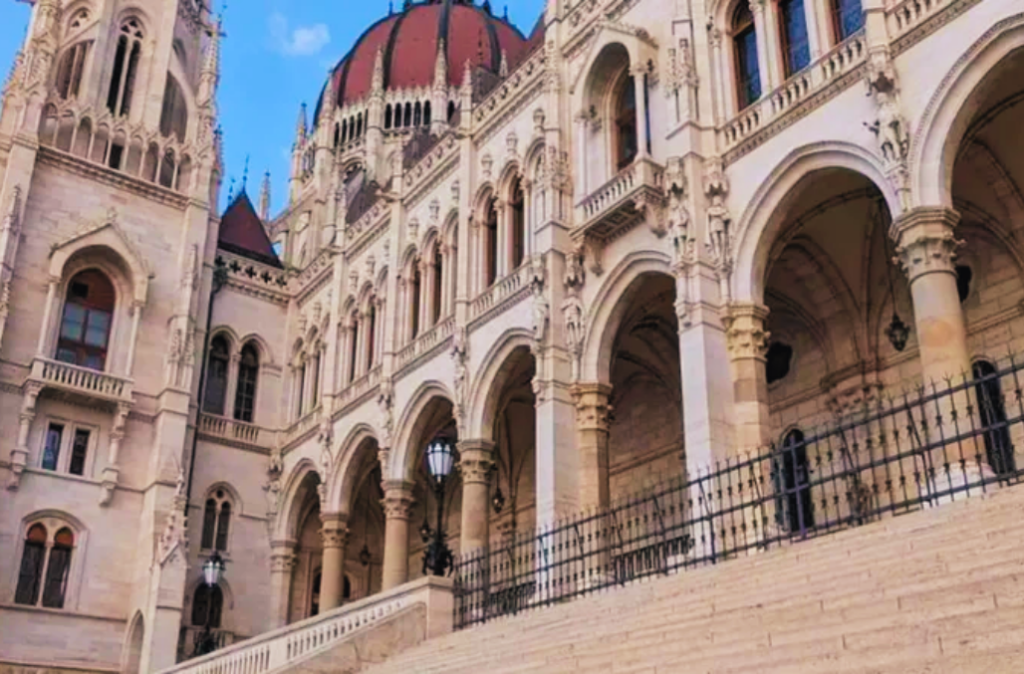
Domes, wide avenues, palaces, and buildings in French, Italian, and Spanish styles are part of the Buenos Aires landscape. This image is closely linked to immigration and the way the city grew between the late 19th and early 20th centuries.
Some streets in Buenos Aires may remind you of Paris, Madrid, or Rome.
This is no coincidence.
Between the late 19th and early 20th centuries, the city experienced a massive wave of European immigration and underwent significant urban growth. Architects, builders, and artisans brought styles and techniques that are still recognizable in many buildings.
That’s why walking through downtown is also a way to explore that history.
1. Avenida de Mayo: One of the Best Streets to Start On
Avenida de Mayo embodies much of that influence.
Between Plaza de Mayo and Congreso, you’ll find buildings in French, Italian, and Spanish styles, with ornate balconies and domes that vary from one block to the next.
One of the best-known examples is the **Palacio Barolo**, inspired by Dante’s Divine Comedy.
It’s just a few blocks from HTL 9 de Julio, and you can walk there from HTL City Baires while strolling down the avenue.
2. Galerías Pacífico: Architecture and Art Under One Dome
At the corner of Florida and Córdoba stands one of the most striking examples in downtown Buenos Aires: **Galerías Pacífico**.
The building was constructed in the late 19th century, inspired by the Bon Marché in Paris. Decades later, its central dome was adorned with murals by Antonio Berni, Juan Carlos Castagnino, Lino Enea Spilimbergo, Demetrio Urruchúa, and Manuel Colmeiro.
It’s very close to HTL Urbano, located at 451 Tucumán Street, just a few meters from Florida Street.
It’s one of those places where it’s worth stepping inside and looking up.
3. Recoleta: Palaces, Mansions, and French-Style Facades
Recoleta showcases another facet of this influence.
Some of its streets still feature historic palaces and residences built by families in the late 19th and early 20th centuries.
The area is dotted with mansard roofs, balconies, columns, and facades reminiscent of French architecture.
The tour can include Plaza Francia, the Recoleta Cemetery, and the streets near Avenida Alvear.
4. San Telmo: Another Europe, Another Scale
San Telmo tells a different story.
Here you’ll find older buildings, courtyards, low-rise houses, and narrow streets.
Spanish and Italian influences blend with an urban fabric that preserves part of colonial Buenos Aires and the city’s early decades of growth.
From HTL City Baires, the historic district and San Telmo are close enough to explore on foot.
5. The Grand Avenues Transformed the Image of Buenos Aires
The European influence wasn’t limited to the buildings.
It’s also evident in the city’s scale.
Avenida de Mayo, Diagonal Norte, and Avenida 9 de Julio were part of a Buenos Aires that sought to modernize and project a monumental image.
That’s why, when you walk through these areas, the atmosphere changes completely compared to neighborhoods with narrower streets.
Where should you look if you want to discover this side of Buenos Aires?
You can start with these five spots:
1. **Palacio Barolo**, on Avenida de Mayo.
2. **Galerías Pacífico**, at the corner of Florida and Córdoba.
3. **Avenida Alvear**, in Recoleta.
4. **Plaza de Mayo and its surroundings**.
5. **San Telmo**, especially around Defensa and Plaza Dorrego.You don’t have to visit them all in one day.
Part of the charm lies in walking around, looking up, and discovering details that often go unnoticed.
From the three HTL hotels, several of these routes start just a few blocks away or connect easily to the historic center.
Why does Buenos Aires look like a European city?